The information here is general in nature and should be checked against your own legal, tax, property, or immigration situation before you act on it.
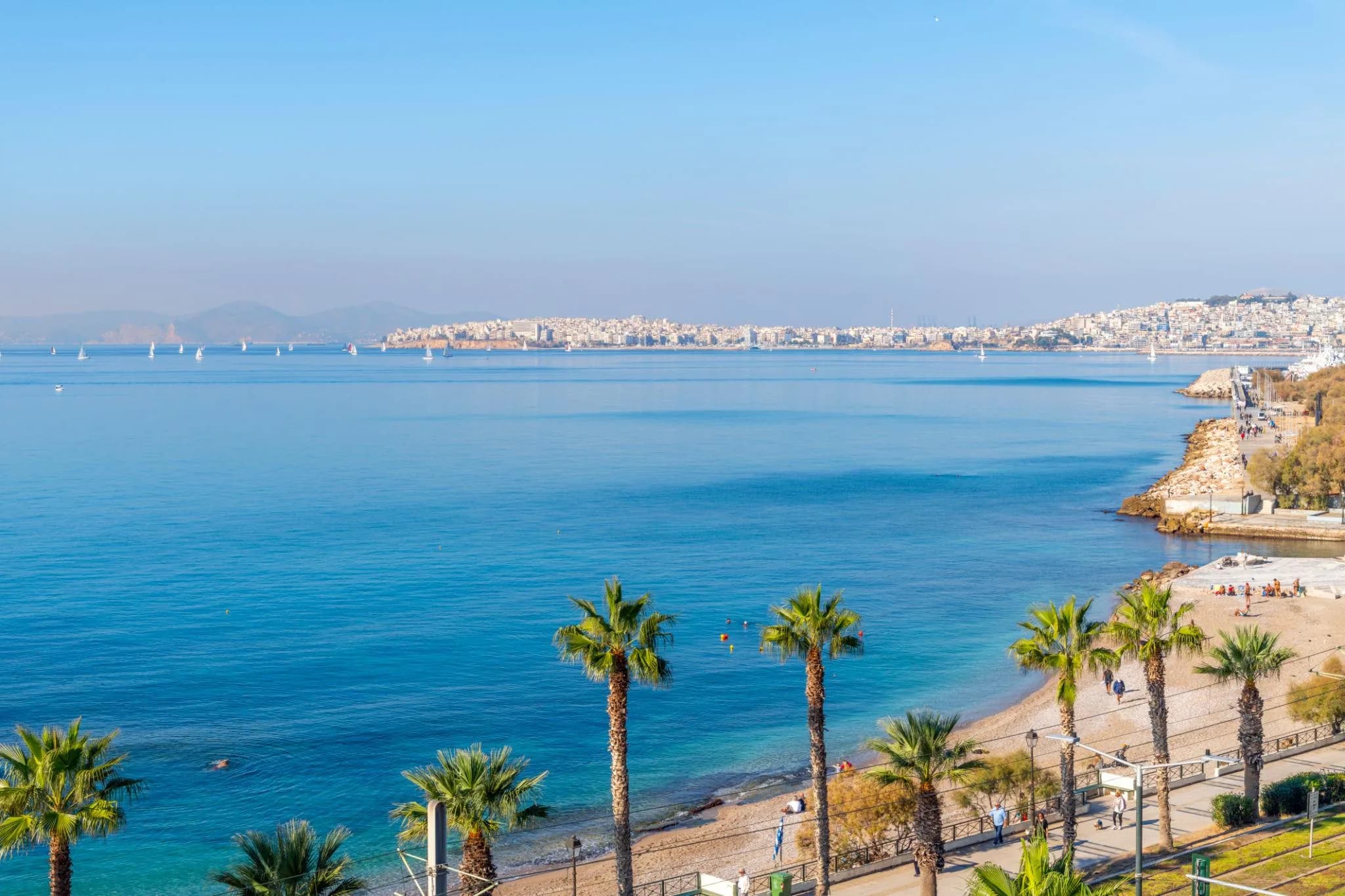
Palaio Faliro is one of those neighborhoods that becomes more impressive the more practical your life is. On a short visit, it can register as simply pleasant: palm-lined waterfront, marina, parks, tramlines, sea views, and a softer pace than the city center. But for buyers, families, relocators, and long-stay professionals, the neighborhood's real value is not just that it looks coastal. It is that it behaves well on ordinary days.
The Official Athens Guide captures the essence of this well. It describes Palaio Faliro as an urban resort and a scenic waterfront suburb that makes an easy escape from the city center, with a ritzy marina, seaside park, and strong waterfront character. Crucially, it also describes the area as a gateway to the Athens Riviera and an easy jump-off point for both Piraeus and the city center. That is the core of the case.[1]
Palaio Faliro works because it is not forcing you to choose between Athens and the sea. It sits in the zone where those two things still cooperate. For many international buyers, especially those who want Greece to function as a real base rather than a holiday-only property, that balance is exactly what they need.
What the neighborhood actually feels like
Palaio Faliro is not an untouched seaside village and it is not pretending to be one. The Official Athens Guide notes that inner streets are dense with apartment blocks, a legacy of postwar growth, while the waterfront promenade, marina, parks, and leisure spaces generate the resort-like feeling people come for. That is an important reality check. The district is successful not because every street is cinematic, but because the daily-life assets are unusually strong.[1]
That distinction matters to buyers. Many people shop emotionally and imagine they are purchasing a permanent vacation mood. In Palaio Faliro, the better lens is livability. Can you walk the promenade before work? Yes. Can children use the parks? Yes. Can you get to central Athens without feeling cut off? Yes. Can you access the airport or the port without turning it into a major event? Usually yes. Those are the things that start to matter once the property is no longer new.
The broader official seaside-neighborhood map from the city also places Palaio Faliro in a strong sequence: it sits among the districts that define the city's seaward life, between the urban logic of Athens and the more fully Riviera-oriented zones farther south. That gives it a strategic in-between quality.[2]
The waterfront is not decoration. It is part of the routine.
One of Palaio Faliro's strongest advantages is that the waterfront is usable, not merely scenic. The city guide emphasizes the Faliro promenade as one of the most scenic places to exercise in Athens, with joggers, cyclists, skateboarders, walkers, and benches stretching along the coast. It also notes that cycle paths continue along the coastline and connect toward nearby areas including Piraeus and farther south toward Glyfada.[1]
For everyday life, that matters enormously. A waterfront that is only pretty from a distance is nice. A waterfront you actually use several times a week changes how a neighborhood lives. It creates a rhythm around movement, exercise, air, light, and social life. It is one reason Palaio Faliro often appeals to people who are not chasing nightlife but are very serious about quality of life.
The same applies to Flisvos Park and the family-friendly outdoor zones the city guide highlights. Whether you have children or not, the existence of parks, play areas, walking routes, and places where life spills outdoors gives the neighborhood resilience. You are not dependent on a few indoor venues to make the area work.[1]
Flisvos Marina is more than a luxury image
Flisvos Marina tends to show up in property marketing as an image of yachts and polished waterfront living. That image is not false, but it is incomplete. The marina's own official material makes clear that its strength lies partly in access. Flisvos states that the tram stop "Trocadero" is directly outside the main entrance, that nearby bus stops connect to Athens, Piraeus, and Glyfada, that the X96 airport express bus stops at Floisvos, and that airport access by car is roughly 40 to 45 minutes depending on traffic.[4]
This is important because it turns the marina from a symbol into an infrastructure asset. Even if you never berth a boat there, the area around Flisvos benefits from a premium waterfront environment that is still integrated into the metropolitan transport web. For international owners and frequent flyers, that combination is rare: you get prestige and utility in the same zone.[4]
Flisvos Marina's own positioning also describes Palaio Faliro as a popular seaside town roughly 6 kilometers from Athens city center and emphasizes easy access to Athens' transport network. That supports the broader argument that Palaio Faliro is not a disconnected luxury strip. It is a functioning urban-coastal district.[5]
Transport is one of the neighborhood's quiet superpowers
People often underestimate how much Palaio Faliro benefits from the Athens transport system. OASA (Athens Urban Transport Organisation), the city's public transport authority, shows just how broad the urban network is, including metro, tram, bus, and airport links, along with tourist ticket products and contactless-payment options. In a coastal district, that matters twice: first because it keeps the neighborhood connected to the city, and second because it keeps the district from becoming car-dependent in the way many waterfront areas elsewhere do.[3]
For residents, the outcome is psychological as much as logistical. A neighborhood feels more "central" when it is easy to leave. You do not need to live in Syntagma to feel connected to Athens. You need a location from which normal city participation is frictionless. Palaio Faliro does that better than many outsiders expect.
That is one reason the area works so well for hybrid lives. If part of your week is city-facing and part is coast-facing, Palaio Faliro does not force you to choose a single identity. You can move between both.
Who tends to do well here
Palaio Faliro works well for several profiles at once. Families often like it because the seafront, parks, and outdoor spaces soften weekday life. Remote professionals like it because the neighborhood is calmer than the historic center but still connected. Semi-retired buyers like it because it feels lighter and more breathable than central Athens without becoming isolated. International households who fly frequently like it because the district sits in a highly functional corridor between central Athens, the Riviera, the airport, and Piraeus.[1], [4], [3]
The district is less ideal for people who want intense nightlife immediately outside the door or who want the feeling of being in the thickest part of Athens' cultural and political pulse. Palaio Faliro is more about ease than intensity. That is exactly why many people choose it.
What week-to-week life looks like here
One of the strongest arguments for Palaio Faliro is that it supports repetition well. A lot of neighborhoods are exciting in a first-impression way but become tiring when you imagine repeating the same routes, errands, school runs, and weekend habits. Palaio Faliro tends to improve under repetition because the neighborhood's strengths are built around routines: a waterfront walk before work, an easy tram or bus route, a park stop with children, a coffee on the marina side, an evening dinner without fighting central-city intensity, or a quick shift into the wider Riviera when you want a slightly bigger outing.[1], [4]
This is also why the district appeals to people who are not trying to be in "vacation mode" all the time. It offers enough beauty to keep life feeling elevated, but not at the cost of functionality. You can live a normal, responsible week here and still feel that Greece is present in the background every day. That is a much rarer quality than buyers often realize.
For households splitting time between Greece and elsewhere, that repeatability matters even more. You want to arrive and slot back into life quickly. Palaio Faliro is good at that because it does not need to be decoded from scratch each time. The neighborhood's logic is simple: coast, movement, outdoor life, and quick access to the wider city.[2], [3]
Palaio Faliro also strengthens the case for an Athens base
Another advantage is how well the neighborhood works as a compromise between full urban commitment and full Riviera distance. Buyers who are uncertain whether they should live in central Athens or farther south often discover that Palaio Faliro resolves most of the argument. You stay close enough to the capital for museums, meetings, and normal services, but you are already living in a district where the sea changes the mood of the day.
That positioning is powerful because it keeps options open. A resident can use the center when they want intensity, use the coast when they want air and space, and move down the Riviera when they want a more extended outing. In a city-region where transport and atmosphere can vary so much from district to district, having that middle position is a serious practical luxury.[1], [3], [2]
Seen this way, Palaio Faliro is not just a neighborhood choice. It is a model for how to live in Athens intelligently: close enough, calm enough, connected enough, and coastal enough to make the city easier to enjoy over the long term.
The Ellinikon effect is real, even before you live inside it
One of the biggest reasons Palaio Faliro matters strategically in 2026 is that it sits in the wider orbit of the Ellinikon transformation. The official Ellinikon project describes the development as a new 15-minute city on the Athens Riviera, with shopping, healthcare, education, sports, entertainment, culture, a major metropolitan park, and stronger pedestrian and cycling connections to the beachfront. That is not small neighborhood news. It is a structural shift in the southern coastal axis of Athens.[6]
The project's own investment-facing materials also frame it as directly connected to the airport, major ports, and important hubs across Athens. In other words, the Ellinikon story is not only about residents inside the project boundary. It is about the re-weighting of the entire Riviera corridor.[7]
Palaio Faliro benefits from that because it is close enough to absorb the broader uplift in attention, amenity gravity, and international perception, while still functioning as an established, livable neighborhood in its own right. Buyers do not need to own inside a megaproject to benefit from its presence. Sometimes the better play is to live just outside the center of gravity while retaining the character and maturity of an existing district.
The Riviera Tower alone is a signal of the scale of change. The official project material describes it as Greece's first green residential skyscraper, 200 meters high, with construction moving toward a first-half-2027 finish. Whether or not a buyer wants that product specifically, the symbolic effect is obvious: the Riviera is being reintroduced to the market at a different level of ambition.[8]
Property strategy: lifestyle first, speculation second
It is tempting to reduce Palaio Faliro to an "investment story" because of the wider Riviera narrative. That is too narrow. The stronger reason to buy here is that the district already works. The Ellinikon effect is a tailwind, not the entire thesis. Good purchases in Palaio Faliro usually start with the basics: walkability to the waterfront, light, layout, transport ease, and whether the home fits your actual daily pattern.
That said, market context still matters. The Bank of Greece's Q4 2025 residential release reported continued year-on-year apartment-price growth in Athens, which reinforces that buying decisions in attractive coastal urban districts are being made inside an active market, not a static one.[9]
For buyers in the Golden Visa segment, Palaio Faliro has an additional layer of relevance because it sits within Greater Athens. But even beyond residency strategy, the neighborhood makes sense for long-hold owners because it offers the rare combination of day-to-day livability, transport logic, coastline, and long-run regional narrative.
The trade-offs are worth naming clearly
No serious neighborhood guide should pretend Palaio Faliro has no trade-offs. Parts of it are dense. Some internal streets are more ordinary than glamorous. It is still part of an active capital region, so road traffic and urban noise do not disappear. If your dream is a total village feel, this is not that. And if your highest priority is being able to walk to every major museum or to a deeply bohemian nightlife scene, you may prefer a more central district.
But these trade-offs are exactly what produce the neighborhood's strength. Palaio Faliro has enough city in it to work, and enough sea in it to breathe. Many buyers discover that this middle condition is more sustainable than either extreme.
Bottom line
Palaio Faliro is one of the clearest examples of smart Athens living because it translates prestige-language into practical life. The promenade is usable. The marina is connected. The parks are real. The transport web is strong. The coast is part of routine, not a once-a-month excursion. And the wider Riviera, led by the Ellinikon transformation, is becoming more important rather than less.[1], [4], [6]
If you want a Greek base that feels lighter than central Athens but more grounded than a purely seasonal coastal town, Palaio Faliro deserves serious attention. It is not just somewhere nice to own. It is somewhere that can make everyday life noticeably better.
Sources
- [1] Palio Faliro Neighbourhood Guide - The Official Athens Guide - Official city guide to Palaio Faliro.
- [2] Neighbourhoods by the Sea - The Official Athens Guide - Official guide to the Athens seaside districts.
- [3] Visit Athens - OASA - Official public-transport guide for Athens.
- [4] Location & Access - Flisvos Marina - Official access details for Flisvos Marina, including tram, bus, and airport links.
- [5] A Distinct Place for Everyone - Flisvos Marina - Official positioning of Flisvos Marina within Palaio Faliro and the Riviera.
- [6] The Ellinikon Project - Official project overview of the new 15-minute city on the Athens Riviera.
- [7] Invest in Real Estate in Greece - The Ellinikon - Official positioning of the project's connectivity and investment logic.
- [8] Riviera Tower - The "Green" Skyscraper - The Ellinikon - Official progress details for a flagship Ellinikon component.
- [9] Indices of residential property prices: Q4 2025 - Bank of Greece - Official Athens residential-pricing context.
Related Guides
- Moving to Greece: A Practical 2026 Guide for Buyers, Families, and Remote Workers
- Day Trips from Athens: The Escapes That Make an Athens Base More Valuable
- Greece Golden Visa in 2026: What the Official Rules Say, What Buyers Miss, and Where Athens Fits
- Living in Athens: What Daily Life Really Feels Like Once the Holiday Mood Wears Off
- Buying Property in Greece: The Process, the Taxes, and the Mistakes Foreign Buyers Can Avoid